
The Case for Leaving Earth
The Caves of SteelThe argument for colonization grows from Fastolfe’s warning into Baley’s own practical and familial commitment, while resistance exposes the emotional costs of change.
increasing Bearing strength in each event
 decreasing
Bearing strength in each eventdecreasingA World Filling Up
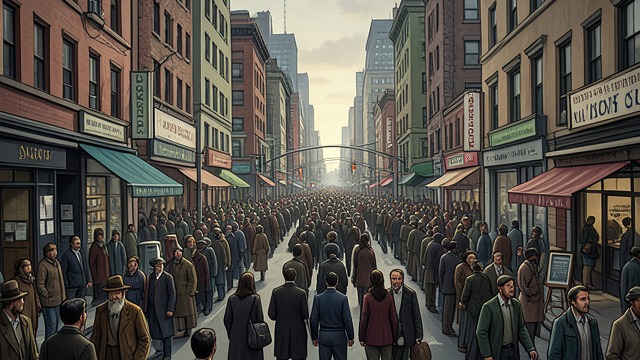
A World Filling Up
Population pressure
Baley reflects on Earth’s eight billion people and the shrinking margin between available calories and basic needs. City culture has postponed crisis through efficiency, but not removed its cause.
Immigration blocked
The Outer Worlds restrict Earthmen from entering, leaving Earth with few outlets for its surplus population. The problem is planetary as well as urban.
The demographic pressure sets the stakes for every proposed solution.
Fastolfe’s Challenge

Fastolfe’s Challenge
The prospect of new worlds
Fastolfe points to the many potentially habitable planets and asks why Earthmen no longer colonize. He argues that City life has made people feel incapable of leaving their familiar systems.
A cultural diagnosis
Baley rejects the charge that Earthmen are coddled but cannot entirely dismiss the possibility. The conversation turns colonization into a question of learned limits, not merely technology.
The challenge lingers after Baley leaves the dome.
Norris’s Counterargument

Norris’s Counterargument
Faith in ingenuity
Philip Norris argues that Earth can solve shortages through future energy technologies, imported resources, and technical innovation. He rejects the need to send people away.
A hidden cost
Baley imagines a planet dependent on distant power stations, imported water, and complex supply routes. A solution that increases capacity might also increase catastrophic vulnerability.
The debate pits confidence in invention against concern for systemic risk.
Baley Persuades Clousarr

Baley Persuades Clousarr
The argument becomes personal
Baley tells Clousarr that Earth can use its population surplus as settlers and that robots can help them establish new societies. He speaks with an urgency he did not previously recognize in himself.
Resistance softens slightly
Clousarr still rejects robots, but Daneel detects a subtle change in his emotional response. The exchange suggests that ideological resistance may not be absolute.
Colonization becomes a position Baley can advocate from experience.
A Family’s Possible Passage
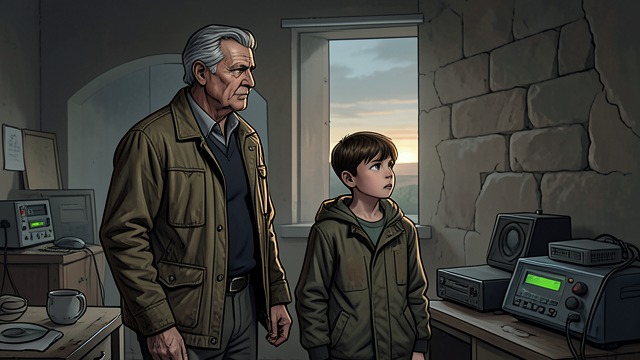
A Family’s Possible Passage
Bentley imagined elsewhere
Baley tells Daneel that he is too old to emigrate but asks whether his son might attend a training school for emigrants. The future is no longer a remote population theory.
Hope with no guarantee
Daneel cannot promise that he will stay or that Bentley will leave. Baley accepts uncertainty while placing his trust in the possibility of another world.
The colonization argument ends as an inheritance offered to the next generation.
During Baley’s expressway reflections
During Baley’s first visit to Spacetown
During Baley’s afternoon at the Department
During the Yeast-town interrogation
In Baley’s final conversation before going home
